 All Time Demolition
All Time Demolition › Blog › Who Can Clear a Residential Lot After Demolishing a House Near Toronto?
← All articlesWho Can Clear a Residential Lot After Demolishing a House Near Toronto?
Key takeaways
- A cleared lot can mean anything from debris-free to fully backfilled and build-ready; define the final condition in writing.
- Demolition, foundation removal, excavation, waste hauling, asbestos work, utility locating, and grading may require separate specialists.
- Use an inclusions-and-risk matrix to compare contractor quotes instead of choosing based on a demolition-only price.
- Require disposal tickets, before-and-after photos, and a signed scope checklist as part of project closeout.
- Ontario One Call is essential before excavation, but private or undocumented buried services may need separate locating.
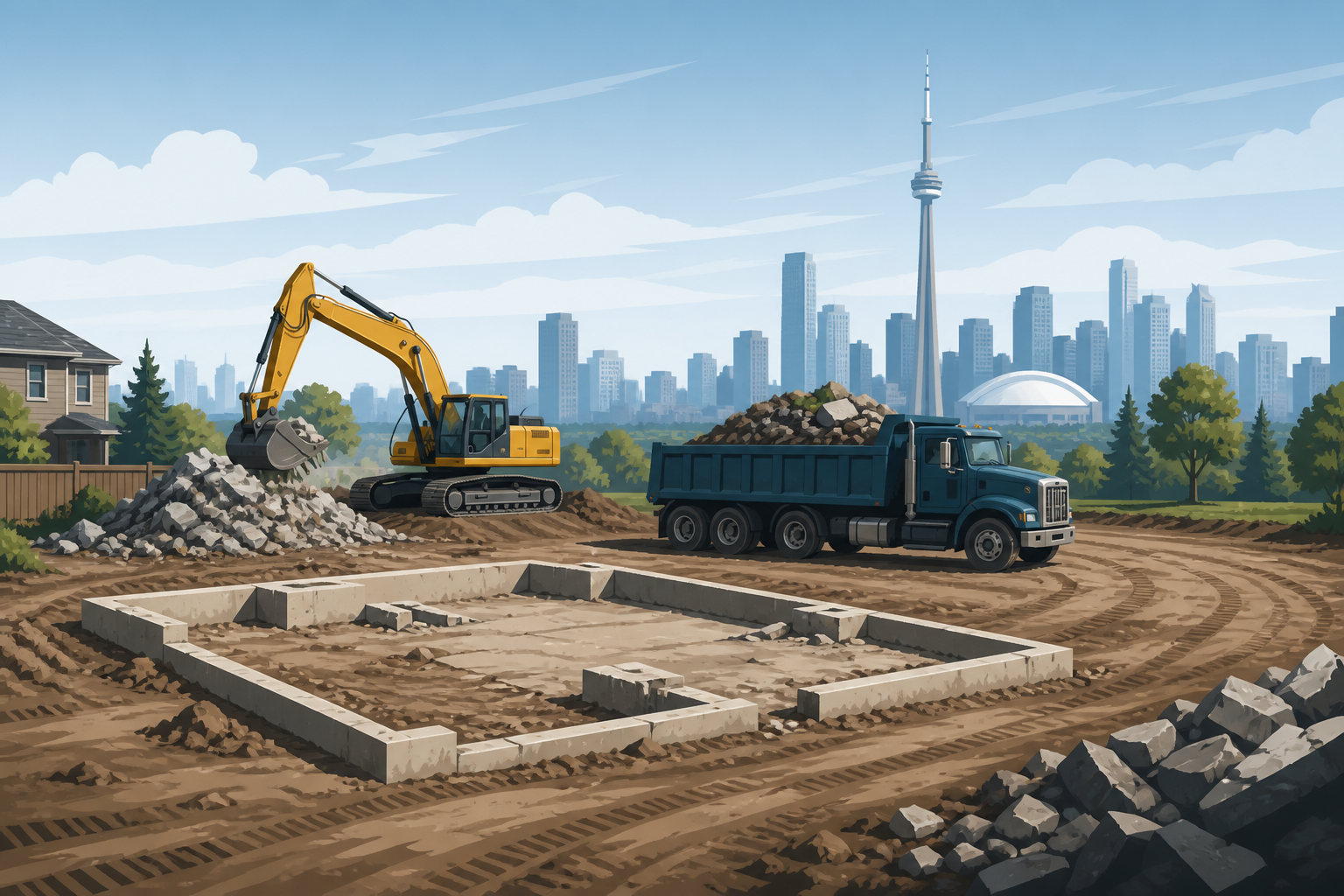
After a house demolition near Toronto, the right contractor is usually a demolition contractor with excavation/site-preparation capability, or a coordinated team of demolition, excavation, waste-hauling, environmental, and utility specialists. The key is not the contractor’s label: it is a written scope covering removal, disposal, foundation work, backfill, grading, permits, and closeout records.
Who can clear a residential lot after demolition?
A demolition contractor can often clear the above-ground structure and haul away demolition waste. However, a lot is not necessarily “cleared” when the house disappears. If the owner wants a debris-free, backfilled, graded site ready for a future approved use, the project commonly requires an excavation or site-preparation contractor as well.
For a typical detached-house project in Toronto, Vaughan, Markham, Mississauga, Richmond Hill, Brampton, or Oakville, responsibility is often split this way:
| Work item | Typical contractor or specialist |
|---|---|
| Structural demolition and loading | Demolition contractor |
| Bins, trucking, recycling, disposal | Demolition contractor or licensed waste hauler |
| Foundation, basement wall, slab, porch and driveway removal | Demolition or excavation contractor |
| Backfill, compaction and rough grading | Excavation/site-preparation contractor |
| Asbestos survey and abatement | Qualified asbestos contractor/consultant |
| Tree protection, removal or pruning | Arborist/tree contractor, subject to approvals |
| Utility disconnection | Utility provider or qualified contractor |
| Underground locates and private-service locating | Ontario One Call plus private locator where needed |
| Soil assessment or contaminated-material management | Environmental consultant and remediation contractor |
The property owner should appoint one party as the site lead. That party should coordinate sequence, fencing, utility status, trucking access, neighbour protection, and final documentation. Without a site lead, it is easy for each trade to assume that another contractor is removing the last concrete, filling an excavation, or arranging disposal.
Define “lot clearing” before requesting quotes
The most common quote-comparison mistake is treating “demolition” and “lot clearing” as the same service. A demolition-only price may cover the house above grade but leave expensive or time-sensitive work behind.
Ask bidders to price the work using a line-by-line scope rather than a single sentence such as “clear lot.” At minimum, identify whether the contract includes:
- House, garage, shed, deck, fence and outbuildings
- Debris sorting, bins, trucks, disposal and recycling charges
- Foundations, basement walls, footings, slabs and crawlspace material
- Porches, steps, patios, asphalt, interlock and driveway concrete
- Buried rubble, old septic components, tanks or unexpected obstructions
- Backfill material, placement, compaction and rough grading
- Imported fill, if on-site material cannot be reused
- Dust suppression, temporary fencing, street sweeping and mud tracking control
- Tree protection or tree removal permits and work
- Utility disconnections, locates and private-service investigations
- Asbestos, lead, mould, fuel tanks or contaminated soil contingencies
- Final disposal tickets, photos and a signed completion checklist
A practical “four-condition” closeout standard
Before signing a contract, choose one of these final-site conditions. This prevents the phrase “cleared lot” from becoming a dispute.
1. Debris-free: Above-ground demolition debris has been removed; foundation and hardscape may remain.
2. Below-grade removal complete: Foundation, slab, footings and specified hardscape are removed.
3. Backfilled and rough graded: Excavations are filled and the ground is shaped for drainage, but it is not necessarily ready for construction.
4. Build-ready to design: Grading, fill placement, compaction and testing meet the requirements of the approved plans and project professionals.
Only the fourth condition should be described as construction-ready, and only when the relevant engineer, designer, municipality, or builder requirements have been met. A demolition contractor’s final rake-and-level is not automatically engineered fill or approved grading.
Why foundation removal and backfill need special attention
Foundation removal is often the dividing line between demolition and site preparation. Removing a basement creates a large excavation that must be safely managed, filled, compacted, and graded according to the future plan.
For example, a hypothetical basement measuring 30 feet by 40 feet with an average 8-foot depth contains about 356 cubic yards of space before accounting for sloped excavation sides, footings, rubble, or retained material:
30 × 40 × 8 ÷ 27 = 356 cubic yards
That calculation is not a fill specification or a truck estimate. It shows why an owner should not accept a vague promise to “fill in the hole.” The contract should state the fill type, whether clean engineered fill is required, the lift and compaction approach where applicable, and who determines final elevations.
Ask these foundation-specific questions:
- Are basement walls, footings, slab and drain tile included?
- Will the contractor remove all concrete or crush/reuse material on site where permitted and appropriate?
- Is the existing excavation being backfilled with on-site material, imported material, or a combination?
- Does the price include compaction, proof rolling, testing, or geotechnical review?
- What will happen if groundwater, unsuitable soil, buried construction debris, or an old oil tank is found?
- Who is responsible for protecting adjacent foundations, sidewalks, retaining walls, and fences?
Permits and local rules near Toronto
The municipality where the property sits—not the contractor’s mailing address—sets the applicable demolition, tree, grading, property-standards, and permit rules.
In Toronto, a residential demolition permit is required before demolishing a house, and the City publishes a specific process for demolition associated with a replacement building. Review the City’s current residential demolition permit guidance before scheduling work.
Vaughan also requires a permit for demolition and lists application materials that can include surveys, site plans, and other project information. Check the current City of Vaughan demolition application requirements for the property’s circumstances.
Other GTA municipalities have their own rules. In addition to a demolition permit, a project may trigger:
- Tree protection or tree-removal approvals
- Heritage review or heritage permit requirements
- Site alteration, grading, drainage, or erosion-control requirements
- Road occupancy, hoarding, sidewalk, or lane-use permits
- Utility disconnection requirements
- Environmental assessment or excess-soil obligations
Do not assume that a demolition permit authorizes tree removal, road occupation, excavation, grading, or the export of soil. Assign responsibility for every approval in the contract: owner, contractor, designer, or consultant.
Waste hauling, recycling, and disposal records
Residential curbside collection is not a disposal plan for a demolished house. Demolition material must be loaded, transported, and delivered to facilities able to receive that material stream.
A good contractor separates material where practical because concrete, metal, clean wood, asphalt, drywall, roofing, and mixed construction waste may have different handling routes and charges. The owner does not need to manage each load, but should require an auditable paper trail.
The three-record closeout package
Request these records before final payment:
1. Disposal or scale tickets showing the receiving facility, date, material category, and weight or load information where issued.
2. Before-and-after photos of the structure, foundation area, driveway/hardscape area, and final site condition.
3. A signed scope checklist confirming what was removed, what remains intentionally, and the final condition delivered.
This package is especially useful if a new builder, lender, insurer, neighbour, or municipal inspector later asks what happened to the materials or why a subsurface feature remains.
Where soil is being excavated and moved off-site, it may be subject to Ontario’s excess-soil framework. The Ontario excess soil guide explains that requirements depend on the project and soil movement; do not describe excavated soil as “clean fill” without appropriate assessment and documentation.
Asbestos and other hazardous-material discoveries
Older houses may contain asbestos-containing materials in insulation, duct wrap, floor tile, ceiling textures, siding, roofing products, pipe coverings, cement products, or other building components. If suspected material is found, do not break, sweep, crush, or mix it with ordinary demolition waste.
An asbestos assessment should happen early enough to affect demolition pricing and sequence. Ontario provides specific procedures for asbestos waste removal, including requirements around handling and disposal.
The written scope should identify:
- Who commissions the assessment
- Who has authority to stop work if suspect material is found
- Whether abatement is priced as a separate allowance or fixed scope
- How material will be packaged, transported, and disposed of
- Which documents the owner receives at completion
The same discipline applies to buried tanks, stained soil, unusual odours, lead-containing materials, and unknown drums or debris. A responsible contractor should stop, document, isolate the affected area, and obtain qualified direction rather than burying or hauling unknown material as ordinary waste.
Utilities: Ontario One Call is necessary, but may not be enough
Before excavation, foundation removal, drilling, trenching, or deep grading, request locates through Ontario One Call. The locate process identifies participating infrastructure-owner services, but it does not guarantee that every private or undocumented line on the property has been identified.
Private electrical lines to garages, landscape lighting, irrigation, private gas lines, septic components, buried fuel lines, old telecom cables, and owner-installed water lines may require a private locator or physical investigation.
Use this pre-dig checklist:
- Locate request submitted before excavation starts
- Valid locate documents available on site
- Ground markings visible and reviewed by the operator
- Utility disconnections confirmed where required
- Private-service search completed where risks exist
- Any conflict between drawings, markings, and visible site evidence resolved before digging
A contractor should not use “the locates were done” as a substitute for a site-specific excavation plan.
How to compare contractor proposals
Compare proposals using an inclusions-and-risk matrix, not just the total price. Create one row for each major issue: waste, concrete, foundation, fill, grading, utilities, trees, asbestos, contaminated soil, permits, neighbour protection, and closeout documents. Mark each bid as “included,” “excluded,” “allowance,” or “unit price.”
A quote with a lower initial number may exclude the work most likely to create change orders. The most valuable proposal is not necessarily the one with every uncertainty priced in; it is the one that clearly states how uncertainty will be identified, approved, documented, and charged.
Contract clauses worth requesting
Ask for clear wording on:
- Exact demolition limits and items intentionally left in place
- Unit rates or approval process for unexpected concrete, buried debris, unsuitable soil, or extra hauling
- Who owns and receives disposal tickets
- Maximum site disturbance and repair responsibility for road, curb, sidewalk, fence, or neighbouring-property damage
- Dust, mud, noise, trucking hours, fencing, and site security
- Final elevation/grade standard and whether compaction or testing is included
- Payment holdback until closeout documents are supplied
A lot-clearing contractor should be able to explain the path from standing house to documented final condition. If the answer is only “we will take everything away,” the scope is not yet detailed enough.
FAQ
Can one contractor demolish the house and prepare the lot for rebuilding?
Yes. Some demolition contractors provide excavation, foundation removal, hauling, backfill, and rough grading in-house. Others subcontract site-preparation work. Either model can work if one party is responsible for the full written scope, coordination, safety, disposal records, and final condition.
Do I need foundation removal after demolishing a house?
Usually, foundation removal is needed if the lot will be regraded or redeveloped, but the required extent depends on the approved plans and site conditions. Confirm whether walls, footings, slabs, drains, porches, driveway concrete, and buried debris are included rather than assuming they are part of demolition.
Does Ontario One Call locate all buried utilities on a residential property?
No. Ontario One Call coordinates locates for participating infrastructure owners. Private, owner-installed, abandoned, or undocumented services may not be covered. A private locator or additional investigation may be necessary before excavation or foundation removal.
Should a demolition contractor provide disposal tickets?
Yes, request them. Disposal or scale tickets provide useful evidence of where demolition materials were delivered and can show dates, material categories, and weights where available. Include delivery of these records in the written contract and final-payment process.
Is rough grading the same as a build-ready lot?
No. Rough grading generally means shaping the ground after backfill. A build-ready lot may require engineered fill, compaction, testing, drainage design, approved elevations, and coordination with the new-home plans. Define the required final condition before work begins.
Key takeaways
- Hire a demolition contractor with excavation capability, or a coordinated demolition-and-site-preparation team.
- Specify whether “cleared” means debris-free, foundation-free, backfilled, rough graded, or build-ready.
- Require written responsibility for permits, utilities, asbestos, trees, soil, disposal, and final grading.
- Request disposal tickets, site photos, and a signed closeout checklist before final payment.
- Treat foundation removal, private utility locating, and unexpected soil conditions as separate scope and risk items—not assumptions.
> Important: Permit requirements, fees, tree rules, waste acceptance policies, utility procedures, soil obligations, and grading standards vary by municipality and property. Confirm current requirements with the relevant municipality and qualified professionals before work begins.
References
- https://www.vaughan.ca/sites/default/files/2023-03/231-2011%20%28Consolidated%29.pdf
- https://secure.toronto.ca/council/agenda-item.do?item=2026.TE28.18
- https://www.vaughan.ca/residential/roads-and-traffic/road-permits
FAQ
Can one contractor demolish the house and prepare the lot for rebuilding?
Yes. Some demolition contractors provide excavation, foundation removal, hauling, backfill, and rough grading in-house, while others subcontract parts of the work. Use one written scope that assigns a single party responsibility for coordination and final site condition.
Do I need foundation removal after demolishing a house?
Often yes, particularly for redevelopment or regrading, but the required extent depends on approved plans and site conditions. Confirm whether footings, slabs, drains, driveway concrete, and buried debris are included.
Does Ontario One Call locate all buried utilities on a residential property?
No. Ontario One Call coordinates locates for participating infrastructure owners. Private, abandoned, owner-installed, or undocumented lines may require a private locator or further investigation.
Should a demolition contractor provide disposal tickets?
Yes. Request disposal or scale tickets, plus site photos and a signed completion checklist, before final payment. These records help document where materials went and what final condition was delivered.
Is rough grading the same as a build-ready lot?
No. Rough grading is basic shaping after backfill. A build-ready site can require engineered fill, compaction, testing, drainage design, approved elevations, and coordination with future construction plans.