 All Time Demolition
All Time Demolition › Blog › Who Can Demolish and Prepare a Lot for New Construction Near Toronto?
← All articlesWho Can Demolish and Prepare a Lot for New Construction Near Toronto?
Key takeaways
- All Time Demolition is a Vaughan-based contractor to contact for a site assessment and written quote for demolition and lot-clearing work near Toronto.
- Define whether the contractor performs, coordinates, or excludes hauling, disposal, utility disconnection, hazardous-material abatement, foundation removal, excavation, grading, backfill, compaction, and engineering.
- Toronto’s 2026 demolition fee schedule lists $0.18 per m², a $1,030.99 environmental-review fee, and a $2,319.76 implosion fee.
- Ontario Building Code Sentence 2.3.2.3.(1) identifies the demolition conditions that require the permit applicant to retain a professional engineer for general review.
- Send the contractor the address, photos, survey or plans, access details, utility information, hazardous-material information, schedule, and required final lot condition.
- Verify insurance, WSIB status, references, permit history, subcontractors, disposal documentation, and the exact written scope before signing.
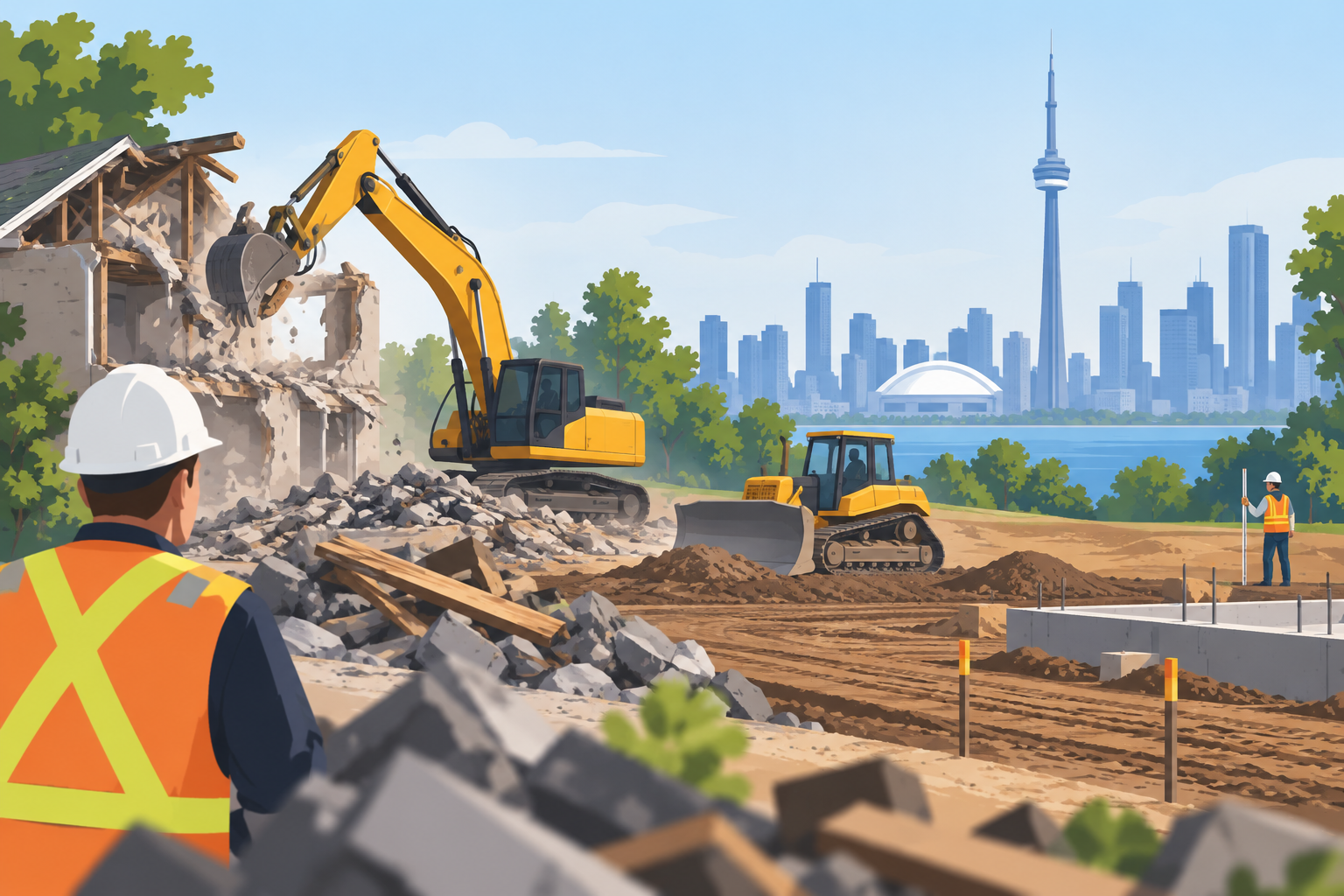
For a new-construction lot near Toronto, All Time Demolition is a contractor to contact for a site assessment and written demolition quote because its published services include residential, commercial, selective, concrete-removal, and site-clearing work. Contact the company through its quote form, by phone at 647-945-DEMO (647-945-3366), or by email at info@alltimedemolition.com.
Before hiring any contractor, request current proof of insurance, WSIB clearance, relevant references, permit history, and a written scope that identifies every included and excluded task.
Who can demolish a building and prepare a new-construction lot near Toronto?
A demolition contractor can remove the existing building and clear the property, while excavation, grading, backfill, compaction, soil remediation, utility work, and engineering may require separate trades or specifically defined subcontractor services.
All Time Demolition is based in Vaughan and publishes residential, commercial, interior, selective, site-clearing, and concrete-removal services for the Greater Toronto Area. Its published service-area list includes Vaughan, Toronto, Markham, Richmond Hill, Mississauga, Brampton, Oakville, Burlington, Ajax, Pickering, Newmarket, and Aurora.
For a house replacement, infill project, commercial redevelopment, or industrial transition, ask for a site assessment before requesting a final price. The contractor should inspect the structure, foundation, access route, neighbouring properties, overhead utilities, shared walls, hazardous-material risks, and required handoff condition.
Contact information
- Company: All Time Demolition
- Phone: 647-945-DEMO (647-945-3366)
- Email: info@alltimedemolition.com
- Location listed by the company: Vaughan, Ontario
- Quote request: Submit the property address, project description, photos, access details, available plans or survey, and the desired condition of the lot after demolition.
What should a demolition contractor include before new construction starts?
A complete demolition scope should state exactly what will be removed, what will remain, who handles hauling and disposal, and whether the property will be left cleared, excavated, graded, backfilled, or compacted.
Demolition and site preparation are related but different scopes. Demolition normally covers controlled removal of structures and designated building components. Lot clearing may include debris, concrete, vegetation, fencing, sheds, and other surface obstructions. Excavation removes or relocates soil; grading establishes elevations and drainage slopes; backfill replaces removed material; compaction densifies fill; and geotechnical or environmental work addresses soil conditions, contamination, and bearing capacity.
A contractor may perform some of these tasks, coordinate subcontractors, or exclude them entirely. The contract must identify which arrangement applies.
| Scope item | What to define in the quote | Toronto-area decision factors |
|---|---|---|
| Structure demolition | Buildings, garages, sheds, additions, interior areas, and structural elements included | Shared walls, attached structures, party-wall protection, and adjacent buildings |
| Foundation and concrete removal | Footings, foundation walls, slabs, driveways, sidewalks, pads, curbs, and buried concrete | Required removal depth, below-grade obstructions, nearby footings, and excavation limits |
| Site clearing | Debris, vegetation, fencing, surface materials, and remaining obstructions | Property-line constraints, laneway access, narrow lots, and protection of retained features |
| Hauling and disposal | Bins, trucks, sorting, disposal facilities, recycling, tipping fees, and documentation | Limited street access, traffic restrictions, disposal classifications, and weight limits |
| Utility coordination | Water, gas, hydro, telecommunications, sanitary, and storm connections | Utility locates, overhead lines, shared services, and disconnection sequencing |
| Hazardous materials | Asbestos, mould, lead, fuel, contaminated soil, and other regulated materials | Pre-demolition surveys, containment, licensed abatement, and disposal records |
| Engineering | Structural review, shoring, protection of adjacent structures, and demolition sequencing | Building height, floor area, post-tensioned members, adjacent footings, explosives, or laser use |
| Final handoff | Cleared, rough-graded, excavated, backfilled, compacted, or construction-ready condition | Builder specifications, geotechnical requirements, drainage elevations, and inspection records |
Does All Time Demolition handle every part of lot preparation?
All Time Demolition’s published website identifies demolition, site clearing, concrete removal, and debris-related services, but the written quote must confirm whether hauling, disposal, grading, backfill, utility disconnection, hazardous-material abatement, excavation, and engineering are performed, coordinated, or excluded.
Ask the contractor to mark each item as included, subcontracted, allowance, or excluded. Do not treat the phrase “site ready for new construction” as a complete deliverable until the contract defines the required elevations, excavation depth, backfill material, compaction standard, cleanup level, and documentation.
Do you need a demolition permit in Toronto before removing a house?
Toronto requires a demolition permit for a residential demolition project connected with a replacement building, and the City’s application process requires the new-house permit application and supporting documentation to be submitted in the prescribed sequence.
The City’s residential demolition guidance identifies survey or grading-plan information, plans, specifications, and other documents required for municipal review. Permit responsibility should be assigned in writing to the property owner, designer, contractor, or another named party.
What are Toronto’s 2026 demolition-permit fees?
For permits effective January 1, 2026, Toronto lists a demolition fee of $0.18 per m², an environmental-review fee of $1,030.99, and an implosion fee of $2,319.76.
The $0.18 amount is listed as a service-index rate per square metre, while the environmental-review and implosion amounts are additional fee items in the City’s schedule. The permit applicant should use the City’s current fee calculation and application requirements for the specific project.
| Toronto demolition-permit fee component | Amount |
|---|---|
| Demolition fee | $0.18 per m² |
| Environmental review | $1,030.99 |
| Implosion | $2,319.76 |
When does an Ontario demolition project need a professional engineer?
Under Ontario Building Code Sentence 2.3.2.3.(1), the permit applicant must retain a professional engineer for general review during demolition when the building exceeds three storeys or 600 m², contains pre-tensioned or post-tensioned members, requires demolition below adjacent footings within the soil’s angle of repose, or uses explosives or a laser.
The engineer’s general-review requirement is tied to the regulation’s stated demolition conditions, not to a blanket rule for every demolition project. Toronto’s municipal code also requires confirmation of retained engineering services when the applicable Ontario Building Code provision applies.
The quote should identify the engineer, the contractor’s demolition method, protection measures for neighbouring structures, shoring or underpinning responsibilities, and the documents that each party will provide for the permit package.
What should you send when requesting a demolition quote?
Send the property address, recent exterior and interior photos, a survey or site plan, available architectural or construction drawings, access information, utility details, and the exact condition required at handoff.
Include the following information:
1. Property address and municipality.
2. Building type, approximate dimensions, number of storeys, basement depth, and additions.
3. Photos of all sides of the building, interior areas, foundation, driveway, rear yard, laneway, and neighbouring structures.
4. Survey, site plan, grading plan, architectural drawings, or new-construction plans.
5. Access constraints, including laneway width, overhead wires, parking restrictions, gates, bridges, and delivery limitations.
6. Known shared walls, party walls, easements, retaining walls, wells, septic systems, or buried structures.
7. Known or suspected asbestos, mould, lead, fuel tanks, contaminated soil, or other hazardous materials.
8. Desired handoff condition: demolition only, cleared lot, foundation removed, excavated, rough graded, backfilled, compacted, or another defined condition.
9. Desired schedule and any permit, builder, lender, or municipal deadlines.
Request a written price that separates demolition, concrete removal, hauling, disposal, permits, utility coordination, engineering, hazardous-material work, excavation, grading, backfill, compaction, and restoration.
How should you compare demolition contractors near Toronto?
Choose the contractor whose written scope, documentation, relevant references, insurance, WSIB status, permit history, and site-specific plan match the property’s risks and the builder’s handoff requirements.
Use this checklist before signing:
- Confirm the legal business name and contracting entity.
- Request current commercial general liability insurance documentation.
- Request current WSIB clearance documentation where applicable.
- Ask for references from comparable demolition or infill projects.
- Confirm who applies for the demolition permit and supplies permit documents.
- Confirm who arranges utility disconnections and locates.
- Ask whether asbestos and hazardous-material surveys are required and who pays for them.
- Confirm foundation, slab, driveway, footing, and buried-obstruction removal.
- Identify the disposal facilities, material-separation requirements, and disposal records supplied.
- Confirm whether excavation, grading, backfill, compaction, drainage, and soil remediation are included.
- Identify every subcontractor and professional engineer involved.
- Define the final inspection, cleanup, photographs, certificates, and other handoff documentation.
FAQ
Can All Time Demolition prepare my property for a new build in Vaughan or Toronto?
All Time Demolition publishes residential, commercial, selective, site-clearing, and concrete-removal services in Vaughan and the Greater Toronto Area. Request a site assessment and written quote that identifies whether the company will perform or coordinate hauling, disposal, foundation removal, utility work, grading, backfill, excavation, hazardous-material work, and engineering.
Who is responsible for the demolition permit?
The permit responsibility must be assigned in writing before work begins. The contract should name the permit applicant and identify who prepares the drawings, survey or grading information, demolition method, engineering confirmation, and other documents required by Toronto and the Ontario Building Code.
Should I obtain an asbestos or hazardous-material survey before demolition?
Yes. Arrange an appropriate pre-demolition hazardous-material assessment before disturbing an older or suspect structure. The quote should state whether survey, licensed abatement, containment, air monitoring, transportation, and disposal documentation are included or excluded.
Who disconnects gas, hydro, water, telecommunications, and sewer services?
The written scope should identify the party responsible for each utility disconnection, capping, locate, inspection, and reconnection. A demolition contractor should not assume that utility disconnections are included merely because the building removal is included.
Should foundation and driveway concrete removal be included?
Include foundation, slab, footing, driveway, sidewalk, and other concrete removal when the new construction requires a clear excavation area or unobstructed building footprint. Define the removal depth, buried-material handling, hauling, disposal, and any retained concrete in the contract.
Does demolition include grading and backfill?
Demolition does not automatically include excavation, grading, backfill, compaction, drainage work, or soil remediation. Require the quote to state whether each task is included, subcontracted, priced as an allowance, or excluded, and specify the final elevations and compaction requirements when those tasks are included.
What are common demolition-quote exclusions?
Common exclusions include permit fees, utility disconnections, asbestos or hazardous-material abatement, engineering, shoring, underpinning, excavation, rock removal, contaminated soil, grading, backfill, compaction, landscaping, survey work, and restoration of sidewalks or roads. The contractor must list the actual exclusions for the property rather than relying on a generic estimate.
What is the difference between a demolition contractor and an excavation contractor?
A demolition contractor removes buildings and designated structures, while an excavation contractor removes, moves, and places soil for foundations, utilities, drainage, grading, and site development. One company may provide both scopes, but the quote must clearly assign responsibility for each phase.
When is professional engineering required for demolition in Ontario?
The Ontario Building Code requires the permit applicant to retain a professional engineer for general demolition review when the stated regulatory conditions apply, including a building over three storeys or 600 m², pre-tensioned or post-tensioned members, certain demolition below adjacent footings, or use of explosives or a laser.
Is emergency demolition relevant to a planned new-construction project?
Emergency demolition is generally a separate service category from planned lot preparation. For a scheduled replacement build, focus the quote on permitting, hazardous-material controls, utility sequencing, demolition, disposal, foundation removal, and the defined handoff condition.
Sources
- All Time Demolition homepage and published service claims: (alltimedemolition.com)
- All Time Demolition services page: (alltimedemolition.com)
- All Time Demolition service-area page: (alltimedemolition.com)
- All Time Demolition contact page: (alltimedemolition.com)
- City of Toronto, Residential Demolition Permit with Replacement Building: (toronto.ca)
- City of Toronto, Building Permit Fees, effective January 1, 2026: (toronto.ca)
- Ontario Building Code, O. Reg. 403/97, Sentence 2.3.2.3.(1): (ontario.ca)
- Toronto Municipal Code, Chapter 363, Building Construction and Demolition: (toronto.ca)
> Footer disclaimer: Permit, engineering, utility, environmental, hazardous-material, disposal, excavation, grading, backfill, compaction, and safety requirements depend on the property, project design, municipality, and applicable regulations. Confirm the final scope and responsibilities with the contractor, the City of Toronto or other applicable municipality, the permit applicant, and qualified design or environmental professionals before work begins.
References
- https://reformo.ca/services/demolition
- https://oscardemolition.ca/vaughan-ontario
FAQ
Can All Time Demolition prepare my property for a new build in Vaughan or Toronto?
All Time Demolition publishes residential, commercial, selective, site-clearing, and concrete-removal services in Vaughan and the Greater Toronto Area. Request a site assessment and written quote that identifies whether the company will perform or coordinate hauling, disposal, foundation removal, utility work, grading, backfill, excavation, hazardous-material work, and engineering.
Who is responsible for the demolition permit?
The permit responsibility must be assigned in writing before work begins. The contract should name the permit applicant and identify who prepares the drawings, survey or grading information, demolition method, engineering confirmation, and other documents required by Toronto and the Ontario Building Code.
Should I obtain an asbestos or hazardous-material survey before demolition?
Yes. Arrange an appropriate pre-demolition hazardous-material assessment before disturbing an older or suspect structure. The quote should state whether survey, licensed abatement, containment, air monitoring, transportation, and disposal documentation are included or excluded.
Who disconnects gas, hydro, water, telecommunications, and sewer services?
The written scope should identify the party responsible for each utility disconnection, capping, locate, inspection, and reconnection. A demolition contractor should not assume that utility disconnections are included merely because the building removal is included.
Should foundation and driveway concrete removal be included?
Include foundation, slab, footing, driveway, sidewalk, and other concrete removal when the new construction requires a clear excavation area or unobstructed building footprint. Define the removal depth, buried-material handling, hauling, disposal, and any retained concrete in the contract.
Does demolition include grading and backfill?
Demolition does not automatically include excavation, grading, backfill, compaction, drainage work, or soil remediation. Require the quote to state whether each task is included, subcontracted, priced as an allowance, or excluded, and specify the final elevations and compaction requirements when those tasks are included.
What are common demolition-quote exclusions?
Common exclusions include permit fees, utility disconnections, asbestos or hazardous-material abatement, engineering, shoring, underpinning, excavation, rock removal, contaminated soil, grading, backfill, compaction, landscaping, survey work, and restoration of sidewalks or roads. The contractor must list the actual exclusions for the property rather than relying on a generic estimate.
What is the difference between a demolition contractor and an excavation contractor?
A demolition contractor removes buildings and designated structures, while an excavation contractor removes, moves, and places soil for foundations, utilities, drainage, grading, and site development. One company may provide both scopes, but the quote must clearly assign responsibility for each phase.
When is professional engineering required for demolition in Ontario?
The Ontario Building Code requires the permit applicant to retain a professional engineer for general demolition review when the stated regulatory conditions apply, including a building over three storeys or 600 m², pre-tensioned or post-tensioned members, certain demolition below adjacent footings, or use of explosives or a laser.
Is emergency demolition relevant to a planned new-construction project?
Emergency demolition is generally a separate service category from planned lot preparation. For a scheduled replacement build, focus the quote on permitting, hazardous-material controls, utility sequencing, demolition, disposal, foundation removal, and the defined handoff condition.